
Confusion is Common
New microgreen growers are most commonly confused during this step in the process.
Not only when to take microgreens out of the blackout period, but if what they are looking at are root hairs or mold.
It is important to not panic. Any mold issues can be dealt with and the decision of when to remove microgreens from the blackout has a wide tolerance.
Removing Trays From the Blackout
Ideally you should see the microgreens doing one or all of the following.
- lifting the lid or cover up off the tray.
- root hairs are absorbed into the plant or the soil.
- the young leaves (cotyledons) have shed the majority of the seed hulls.
Lifting the Lid
The microgreens might not lift the lid while the weight is sitting on top of the tray. This will depend on the variety. Some microgreens like radishes, sunflower, and even broccoli have no problem lifting the weight.
Other microgreens like amaranth or mustards might not have the power to do so. However, when you carefully lift the weight you will notice that the lid (or tray separator) has rising.
This is a good sign the microgreens are ready for the lights.
Root Hairs are Gone
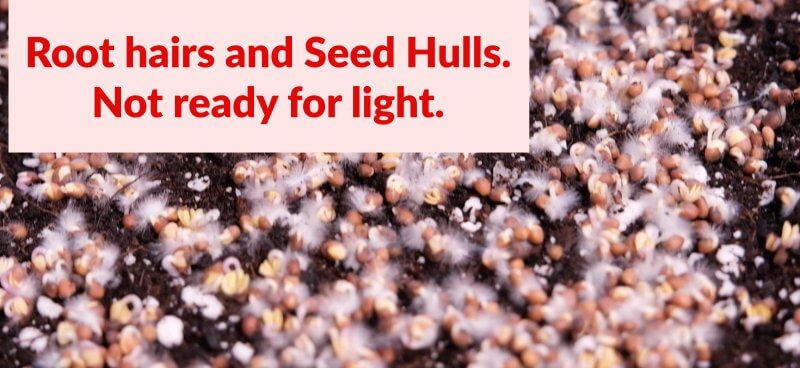
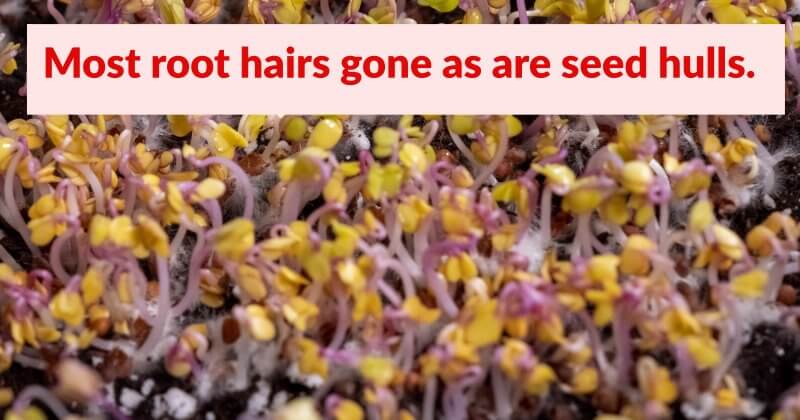
When most of the root hairs are gone it is an indication that the tray can go under the lights. Microgreens will grow in different stages, so some of the plants will still show root hairs, what we are looking for is a majority of the plants have absorbed their root hairs.
Seed Hulls Off the Plants
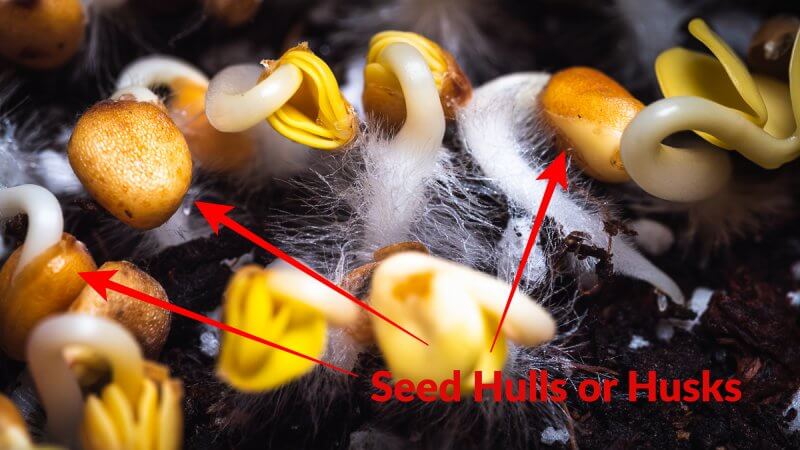
As with the root hairs, not all of the seed hulls need to be shed. In fact, some microgreens such as sunflowers, beets, and Swiss chard can retain some seed hulls throughout the growing stage. We are looking for a majority of the hulls off the leaves.
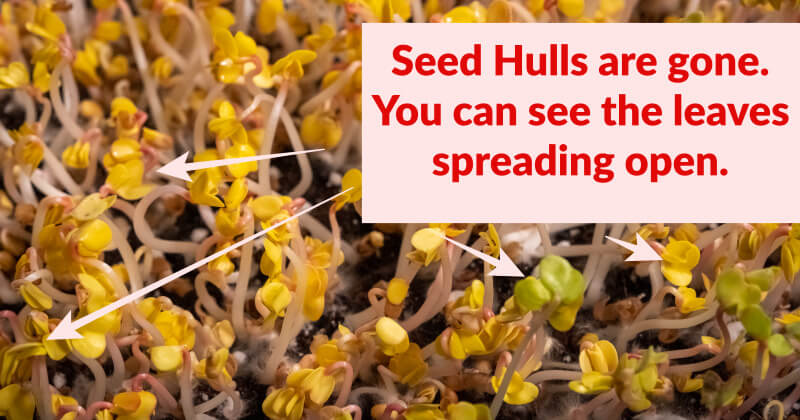
Combine this with no root hairs and plants lifting the lid you can be sure the microgreens are ready for the light.
Sooner is Better than Later
When in doubt, placing the microgreens under the lights sooner than later is best. Optimizing when to place them under the lights will speed up the process for harvest.
But leaving them too long can slow down this process, cause the microgreens to grow at angles (some varieties), and increase the probability of mold issues.
Putting trays under the lights too soon will only slow down the growing process and do little harm unless the seeds have not germinated at all.
So when in doubt, place them under the lights.
Like everything in life, experience is the best tool for learning. So watch how the microgreens grow and modify your steps if the result is not to your liking. Don’t be afraid to make a mistake, but rather learn from it if there is a bad result. Usually, everything will be fine!
Mold or Root Hairs
I can’t even count how many panicked emails I have received with photos of tray with people asking of that is mold on their microgreen tray.
Much less than it used to be, so maybe I have done a better job with explaining the issue.
Luckily, more often than not the photos show root hairs. Lifting the lid and seeing a tray of white can cause panic to set in. But look closely at the plants before stressing.
Root hairs can fill the tray, but each hair will lead to the radicle of the microgreen usually close to a 90-degree angle from the root.
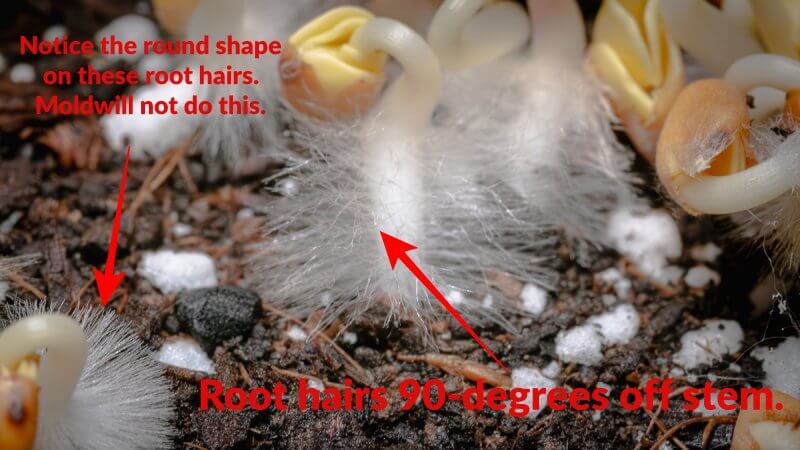
Mold will form in clumps that stretch across the seed and root onto the potting soil particles. As in the mold growing on the potting soil below and over the small seeds.

There can be both, but a little mold is not harmful at this stage. Light and air movement will kill small patches of mold, especially when the top of the tray dries out.

The small patch of mold will die when air and light get to the tray. It is nothing to worry about.
When you see patch like in the photo below is when you have more trouble. The oval dead spot in the middle of the tray was caused from over heating. It could have been caused by a seed heat mat (don’t use one), very hot conditions outside the tray, or a potting mix that did not compost completely (common in the mad rush for growing supplies during the pandemic). I forget which this was.
Although it doesn’t look like mold, it is, and it’s commonly referred to as “damping-off-disease.”

Discussing how to take care of larger mold issues is beyond the scope of this course. But below are a couple of articles that can help you.
Eleven Proven Ways to Stop Mold
How to Prevent the Most Common Diseases
I also have some podcasts on the subject.
